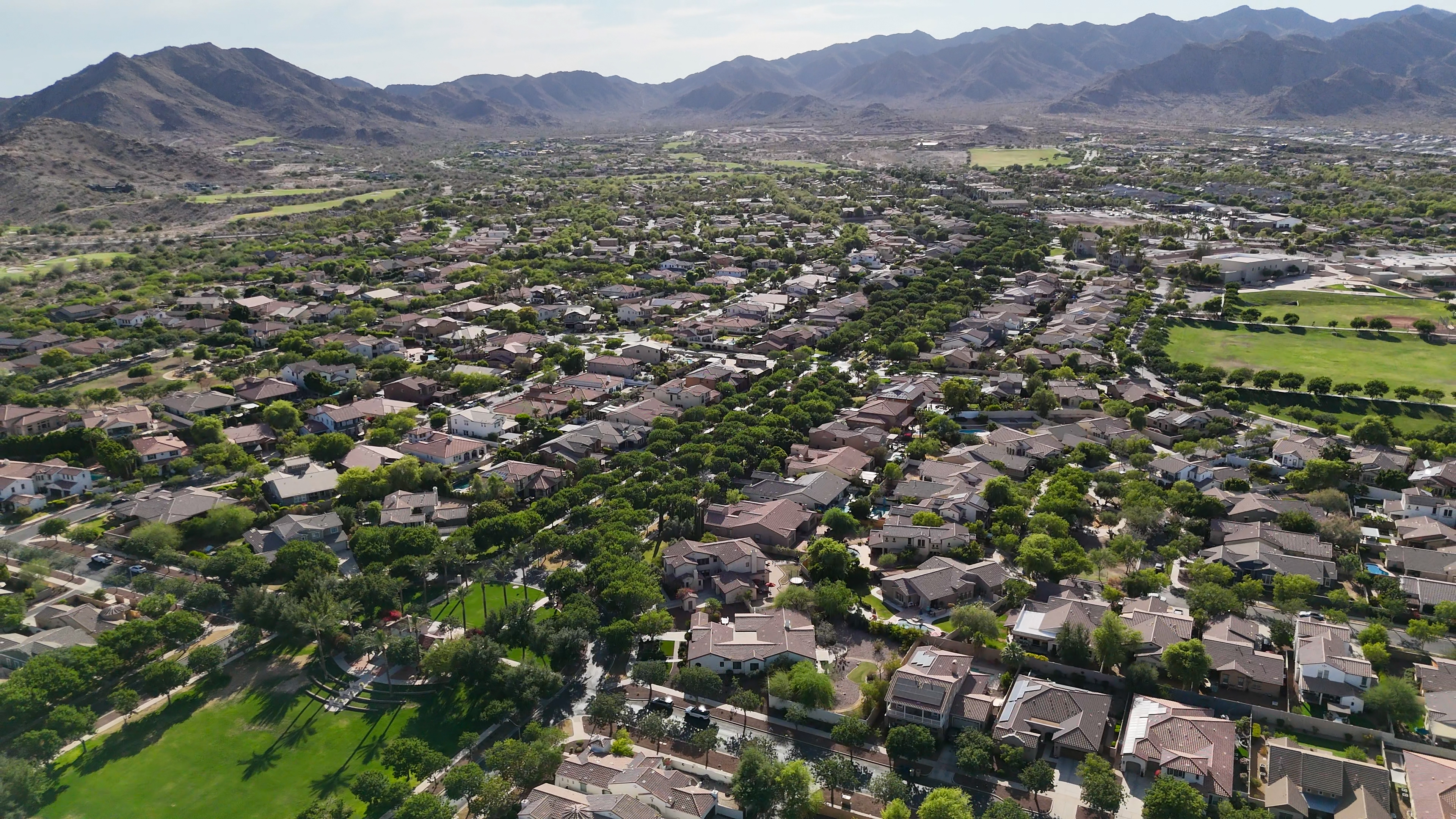
Everyone talks about how fast Buckeye is growing. And it's a fair thing to talk about — new rooftops go up here faster than almost anywhere else in the country. But before all those new homes, there was Old Town. Long before Verrado had a Main Street of its own, Buckeye already had one, and it's still there, a few miles south, doing exactly what it's always done.
A Canal, Not a Developer, Built This Town
Buckeye's story doesn't start with a master plan. It starts with water. In 1877, a group of settlers led by Thomas Newt Clanton made the trip from Iowa to the Arizona desert, and by 1885, settler Malie M. Jackson — along with partners J.L. Spain and Henry Mitchell — had started digging what became the Buckeye Canal, named for Jackson's home state of Ohio. Clanton himself built the first five miles of it, finished in 1886.
The town that grew up around that canal was first platted in 1888 under the name "Sidney," but the post office had already been registered as Buckeye that same year, and the name stuck with residents long before it became official. In 1910, Sidney was formally replatted as Buckeye. What became downtown Buckeye — Monroe Avenue — was laid out around the canal that made the whole area farmable in the first place.
The Railroad Moved the Whole Town
In 1910, the Arizona Eastern Railroad reached Buckeye, and it changed the town's shape almost overnight — the business district actually relocated to sit closer to the new train station. The first automobile showed up in 1911, a steam rail connection to Phoenix followed by 1912, and a state highway reached Buckeye by 1915. In the span of about five years, a farming settlement built around an irrigation canal turned into a town connected to the rest of the territory.
Downtown, Brick by Brick
Buckeye incorporated as a town in 1929, with Hugh M. Watson serving as its first mayor and founder of Buckeye Valley Bank. A lot of what gives Old Town its character today was built in the decades on either side of that: the Ware Building on 4th Street went up in 1910 and housed Buckeye Valley Bank starting in 1911; the Old Courthouse and Jail followed in 1912 and, according to local historians, still has its original jail bars; the H.E. Kell and Co. General Merchandise Building dates back to 1890 and now houses the Buckeye Valley Museum.
Monroe Avenue itself picked up more of its familiar storefronts through the 1920s, '30s, and '40s — the Buckeye Pharmacy building around 1920, the Buckeye Women's Club in 1935 (now on the National Register of Historic Places), and the Millstone Café building in 1944, which served residents and the soldiers stationed nearby during World War II. None of this was planned as a "historic district" at the time. It's just what a working small town looked like as it grew, one building at a time.
Meet Hobo Joe
If you've driven through Old Town, you've probably noticed him: a 25-foot fiberglass statue of a friendly vagabond, standing watch over Main Street. Hobo Joe started out in the 1960s as the mascot for a Phoenix-area chain of coffee shops, designed by a former Walt Disney Company animator. When the chain closed in the late 1980s, most of the statues disappeared — but Buckeye's ended up in storage behind a local meatpacking plant, and was put on display there in 1989.
When that property faced foreclosure in 2016, the Buckeye Main Street Coalition stepped in, raised the funds to save the statue, restored it, and relocated it to downtown Main Street in 2020. It's a genuinely odd piece of roadside Americana, and it's exactly the kind of thing that doesn't get built new — it survives because a community decided it was worth keeping.
Old Town Today
The Buckeye Main Street Coalition, a local nonprofit, describes its mission as building a community that thrives "while honoring and preserving the rich heritage of Old Town" — and that's a pretty accurate description of what's actually happening down there. Between the Downtown Library and Museum, Benbow Veterans Park, more than 170 small businesses, and community events like the annual art walk, Old Town isn't a preserved-in-amber museum piece. It's a functioning downtown that happens to be over a century old.
It also traces its roots to the same tradition as the modern Buckeye Days celebration — the Chamber of Commerce first launched "Helzapoppin Days" back in 1935, with street dances, parades, and rodeos, and some version of that community celebration has continued ever since.
From 6,500 People to Nearly 120,000
Here's where the growth everyone talks about actually shows up in the numbers. Buckeye had 6,537 residents in 2000. By 2010, that was 50,876. By 2020, it was 91,502. Current estimates put the city at roughly 119,317 residents as of mid-2025 — with almost 6,000 of those added in just the past year. Buckeye was the fastest-growing city in the entire United States in 2017, 2018, and 2021, and it officially became a city (rather than a town) on January 1, 2014.
That kind of growth is almost impossible to picture next to a town platted around a single irrigation canal in 1888. But it's the same place. The Verrados and Tartessos and new master-planned communities filling in the desert around Buckeye today are, in a real sense, still growing out from that same original canal town — they just don't look like it anymore.
Why It's Worth Knowing This
I sell a lot of new construction in Buckeye, and I love it — the amenities, the planning, the way these communities are designed. But I also think it matters to know what was here first. Old Town Buckeye isn't a footnote to the growth story; it's the reason there was a Buckeye for all that growth to happen around. Next time you're out that way, it's worth the detour down Monroe Avenue — grab a coffee, say hello to Hobo Joe, and see the place that started it all.
Curious how Old Town connects to the neighborhoods I show buyers every week — Verrado, Tartesso, and everything in between? I can walk you through how Buckeye's history shapes its neighborhoods today.
Reach Out With What You're Looking ForFrequently Asked Questions
How old is Buckeye, Arizona?
Buckeye's roots trace to 1877, when settlers led by Thomas Newt Clanton arrived from Iowa, with the Buckeye Canal built starting in 1885. The town was formally platted in 1910 and incorporated in 1929, making Old Town well over a century old.
What is Old Town Buckeye?
Old Town Buckeye is the historic downtown core built around Monroe Avenue, home to the city's original early-1900s buildings, the Buckeye Valley Museum, the Hobo Joe statue, and an active small-business district maintained today by the Buckeye Main Street Coalition.
How fast is Buckeye growing?
Buckeye's population grew from about 6,537 in 2000 to roughly 119,317 as of mid-2025. It was the fastest-growing city in the United States in 2017, 2018, and 2021, and became an official city in 2014.
Curious what your current home might be worth?
Get a Free Home ValuationSources: Buckeye, Arizona — Wikipedia; City of Buckeye — Our Story; List of historic properties in Buckeye, Arizona; Buckeye Main Street Coalition; Hobo Joe: The Enduring Symbol of Buckeye, Arizona; InBuckeye.com — population data. Information deemed reliable but not guaranteed. Faith Vance, REALTOR® | 3rd Base Realty Group, LLC | AZ License SA633174000 | ARMLS Member. Equal Housing Opportunity.